The Asia Partnership on Emerging Infectious Diseases Research (APEIR) was initiated in 2006 to promote regional collaboration in avian influenza research. In 2009, the partnership expanded its scope to include all emerging infectious diseases. APEIR is a research partnership, composed of researchers, practitioners and senior government officials from Cambodia, China, Lao PDR, Indonesia, Thailand and Vietnam.
APEIR has accomplished several major achievements in three key areas: knowledge generation (i.e., through research), research capacity building (e.g., by coordinating multiple researchers in developing high-quality research proposals, planning and conducting joint research projects), and policy advocacy (e.g., by disseminating research results to policy makers).
During its first phase, APEIR has focused on five key areas of research: (i) What constraints are governments facing in making difficult policy decisions on emerging infectious diseases within their respective national circumstances?; (ii) How are avian influenza and measures to control it affecting poor and small farmers in the region?; (iii) How can bio-security on small farms be improved?; (iv) What control measures are most efficient and effective and under what circumstances?;and (v) What roles do migratory birds play in the transmission of avian influenza, and how can countries improve collaboration in wildlife health surveillance?
APEIR has been generously supported by Canada’s International Development Research Centre (IDRC) and welcomes the participation of other donors.
The APEIR Vision and Missions
Vision of APEIR:
To be the leading EID research network in Asia by 2015.
The APEIR Mission:
To develop a strong regional partnership in Asia that generates multi-disciplinary collaborative research on emerging infectious diseases based on ecohealth/onehealth concepts, and which facilitates communication and knowledge sharing among countries to reduce the threat of EIDs and the burden on these countries, especially on poor and marginalized groups in the region.
The APEIR Partnership Organizational Structure
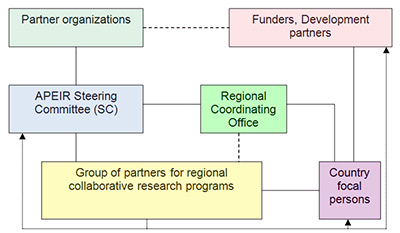
1. A regional partnership steering committee (SC): The PSC consists of 2 representatives from each of the countries involved in the Partnership: Cambodia, China, Indonesia, Laos, Thailand and Vietnam as well as representatives from several donor organizations including IDRC. The PSC is responsible for providing overall guidance, coordination and supervision.
2. A small supporting regional coordinating office (CO): The CO is based at the Health Systems Research Institute of Thailand and led by an Asian coordinator. The CO is responsible for managing the day-to-day organizational matters of the Partnership which include: (i) supporting all regional activities planned by the Partnership; (ii) sharing information relevant to national and regional coordination; (iii) organizing and planning SC and other related meetings; and (iv) assisting country focal persons to link research findings to regional and international policy.
3. Country focal person: Each country assigns a country focal person who is responsible for coordinating the Partnership activities. This person is affiliated with one of the Partner institutions and serves as the key point of contact for communicating and coordinating national activities of the Partnership, and bringing all necessary partners within the country together to develop the network. The country focal person coordinates national activities decided by the Steering Committee and works closely with the Steering Committee and the Coordinating Office to ensure that the country’s participation in the various Partnership research activities runs smoothly.
4. Group of partners for collaborative research program: Research groups were formed by researchers from the Partnership member countries to jointly develop research proposals and implement research activities in each country with the same framework and methodologies. Findings from the studies are shared within the Partnership and with other donors. One lead institution from each research group is responsible for coordinating overall research and overall reporting to IDRC and the Partnership Steering Committee.
The APEIR 2007-2008 Plan
Priority topics to be researched were identified during the international workshops in Beijing, China (April, 2006) and Halong, Vietnam (October, 2006). The first set of five topics was selected as priority by the Partnership for the period from 2007 to 2008. Researchers from the six member countries formed five research teams to develop and implement the following research studies.
1. Wild Bird migratory group
Four countries (Thailand, China, Indonesia and Vietnam) participate in the project with the title “Forming of regional network for surveillance and monitoring of Avian Influenza viruses in migratory birds”. The general objective of the project is to enhance at the regional level the early detection and characterization of Avian Influenza infection and reporting in migratory birds through a coordinated surveillance network. The specific objectives of the study are (i) to confirm suspected and identify additional key species of migratory birds that have the potential to play a role in spreading AI viruses between participating countries; (ii) to study the diversity of AI virus infection in selected key species of migratory birds; (iii) to study the distribution pattern (geospatial and temporal) of key selected species of migratory birds in each country; (iv) to carry out the surveillance and monitoring of avian influenza in migratory birds through the establishment of a regional network and (v) to improve understanding and disseminate the scientific information on the role of migratory birds in spreading avian influenza to different audiences.
2. Socio-Economic Impact group
Social and economic impact research group was formed with the team members from China, Indonesia, Vietnam, and Thailand with the project title: Socio-Economic Impact of HPAI outbreaks and control measures on small-scale and backyard poultry producers in Asia. The main objective of the study is to inform the development of viable control strategies and more equitable interventions to cope with AI, especially for particularly vulnerable households, by analyzing the socio-economic impacts of AI outbreaks and AI control measures on backyard and small producers. Thespecific objectives include: (i) to assess and measure how the livelihoods and wellbeing of backyard and small producers are affected by AI outbreaks and different control measures; (ii) to understand how backyard and small producers respond with respect to farm and market practice to AI outbreaks and different control measures; (iii) to mitigate adverse social and economic impacts of AI and AI control measures by analyzing the implications for the design and implementation of control measures and other interventions
3. Backyard chicken group
Five countries (Cambodia, China, Indonesia, Thailand and Vietnam) jointly conduct this study namely Characteristics and dynamics of backyard poultry systems in 5 Asian countries in relations to reduce and manage Avian Influenza risks. The specific objectives of the project are: (i) Describe and analyze characteristics and dynamics of backyard poultry systems; (ii) describe the networks through which poultry form backyard flock move; (iii) identify and promote changes in backyard poultry systems at various scales and (iv) facilitate conversation and feedbacks between backyard farming stakeholders and policy makers at several scales.
4. Policy analysis group
Three countries (Indonesia, Thailand and Vietnam) jointly participate in the project called “Policy Analysis for Pandemic Influenza Preparedness”. The general objective of the study is to describe the policy making process regarding antiviral drugs and poultry vaccination. The specific objectives are: (i) to define the content of antiviral drug and poultry vaccination policies in Indonesia, Thailand and Vietnam; (ii) to determine the contextual factors which influence the development of antiviral drug and poultry vaccination policies; (iii) to describe and analyze the process of policy making; (iv) to conduct comparative analyses to describe policy, context and process differences and similarities and (v) to determine influencing factors in policy formulation that may be important in future policy making processes
5. Control measures group
Four countries (China, Indonesia, Thailand and Vietnam) jointly conduct this study namely Studies on the effectiveness of Avian Influenza control measures in the Asian partnership countries. The general objective of this study is to evaluate factors contributing to the success in prevention and control of Avian Influenza in the poultry sector within four. The specific objectives include: (i) describe and analyze recommended measures on prevention and control of Avian Influenza; (ii) evaluate effectiveness of control measures applied in poultry farms.
Findings from these studies are extremely important to the development of national preparedness strategies for avian influenza in each country as well asa joint strategy for the region as a whole.
The first set of five research studies is only the initial step for the APEIR Partnership. New research interests and modalities have been and will continue to be identified.
In August 2009, the Partnership led a strategic planning workshop and produced "APEIR Strategic Plan, 2010-2013: Building Strong Social Capital against EIDs." This strategic plan was endorsed in January 2010 by the APEIR Steering Committee at their meeting in Kunming, China.
Co-ordinator
Ms. Pornpit Silkavute (Thailand)
APEIR Manager, Health Systems Research Institute, Ministry of Public Health, Thailand Tel: 662-832-9212 Fax: 662-832-9201 Email: pornpit@health.moph.go.th
Drh. Andri Jatikusumah, M.Sc (Indonesia)
APEIR Coordinator, Health Systems Research Institute, Ministry of Public Health, Thailand Tel: 662-832-9259 Fax: 662-832-9201 Email: andro_fkh@yahoo.com
Mrs. Thanaporn Chaijit (Thailand)
Manager Assistant, Health Systems Research Institute, Ministry of Public Health, Thailand Tel: 662-832-9220 Fax: 662-832-9201 Email: thanaporn@hsri.or.th
Wichukorn Suriyaowongpaisal (Thailand)
APEIR Assistant, Health Systems Research Institute, Ministry of Public Health, Thailand Tel: +662-832-9258 Fax: +662-832-9201 Email: wichukorn3@gmail.com
Country Focal Persons
Dr. Wiku Adisasmito (Indonesia)
Department of Health Policy & Administration, Faculty of Public Health, University of Indonesia. Kampus UI Depok, Tel: 62-21-70494828 Fax: 62-21-75904865 Email: wiku.adisasmito@gmail.com
Director, Animal Health and Production Department, Ministry of Agriculture, Forestry and Fishery Tel: 885-12-829283 Fax: 855-23-991659 Email: nahpic@yahoo.com
Dr. Liu Lin (China)
Center for Molecular Virology. Institute of Microbiology, Chinese Academy of Sciences. Beijing 100080, PR China Tel: 86-10-62557874 Fax: 86-10-62638846 Email: Liulin@mail.im.ac.cn
Ms. Pornpit Silkavute (Thailand)
Country Coordinator, Health Systems Research Institute, Ministry of Public Health, Thailand Tel: 662-832-9212 Fax: 662-832-9201 Email: pornpit@health.moph.go.th
Steering Committee
Dr. Pongpisut JongudomsukChairman
Health Systems Research Institute, Ministry of Public Health, Thailand Tel: 662-832-9200 ext. 9233 Fax: 662-832-9201 Email: pongpisut@hsri.or.th
Dr. Wiku Adisasmito (Indonesia)
Department of Health Policy & Administration, Faculty of Public Health, University of Indonesia. Kampus UI Depok, Tel: 62-21-70494828 Fax: 62-21-75904865 Email: wiku.adisasmito@gmail.com
Director, Communicable Disease Control Department Ministry of Health, Cambodia Tel: 855-12-856848 Fax: 855-23-882317 Email: touch358@online.com.kh, chhanly@yahoo.com
Dr. Amin Soebandrio (Indonesia)
Deputy Minister for S & T Networks (ad interim) and Ministers Advisor on Health & Medicine, Ministry of Research and Technology, Republic of Indonesia Tel: 62-21-3169923 Fax: 62-21-3101829 Email: amin0207@rad.net.id, sa-ko@ristek.go.id
Dr. Qiyong Liu (China)
Assistant Director, National Institute for Communicable Diseases Control and Prevention (ICDC), Chinese Centre for Disease Control and Prevention (China CDC) Tel: 86-10-58900738 Fax: 86-10-58900790 Email: liuqiyong@icdc.cn, liuqiyongcdc@126.com
Dr. Prasit Palittapongarnpim (Thailand)
Vice President for Research, Mahidol University, Thailand Tel: 66-818674202 Fax: Email: prasit@nstda.or.th
Dr. Frank (Wenjun) Liu (China)
Director, Center for Molecular Virology. Institute of Microbiology, Chinese Academy of Sciences Tel: 86-10-62557874 Fax: 86-10-62638846 Email: liuwj@mail.im.ac.cn, frankliu16716@yahoo.com
Dr. Dominique Charron (Canada)
Program Leader, Ecosystems and Human Health, Agriculture and Environment, International Development Research Center, Canada Tel: 1-613-696-2079 Fax: Email: dcharron@idrc.ca
Dr. Le Thi Huong (Vietnam)
Deputy Director, Institute for Preventive Medicine and Public Health, Hanoi Medical University, Vietnam Tel: 84-0915648237 Fax: 844-3574-7240 Email: hathuhuong@yahoo.com, lehuonghmu@yahoo.com
APEIR Coordinating Office
Health Systems Research Institute
National Health Building Floor 4
Ministry of Public Health
Nonthaburi 11000, Thailand
Tel: (66) 2832-9200 (ext.9212); Fax: (66) 2832-9201
Email: pornpit@health.moph.go.th; andro_fkh@yahoo.com; wichukorn3@gmail.com, apeir.co@hotmail.com
Web Developer: Boontium Kongsaktrakoon. Bangkok, Thailand. (boontium_k@hotmail.com)